
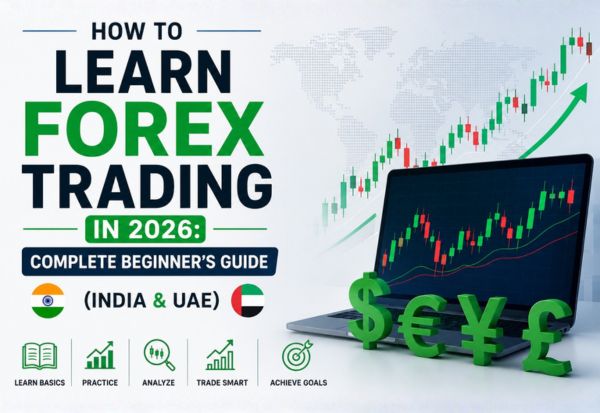
How to Learn Forex Trading in 2026: A Complete Beginner’s Guide
Purchasing one currency and selling another at the same time in order to profit from changes in the two currencies’ exchange rates is known as forex trading. According to the Bank for International Settlements’ Triennial Survey, global daily turnover reached approximately $9.6 trillion in April 2025, up 28% from $7.5 trillion just three years earlier, making it the world’s largest financial market. The difference between traders who survive and the approximately 74–89% of retail accounts that become unprofitable is learning it correctly before risking real capital.
In this guide you’ll learn what forex trading is really like, whether it’s legal where you live, the basic concepts you need to know before your first trade, a structured framework for learning it, and the mistakes that sink most beginners.
What is Forex trading, really?
A forex trade involves a currency pair, a base currency, and a quote currency, such as EUR/USD or USD/INR. When you “buy” EUR/USD, you are betting that the euro will get stronger versus the dollar. When you “sell,” you expect the opposite.
The market operates 24 hours a day in four overlapping sessions—Sydney, Tokyo, London, and New York—with the largest share of daily volume in major pairs such as EUR/USD occurring during the London-New York overlap (roughly 12:00-16:00 UTC). That 24-hour setup is one of the reasons forex is attractive to beginners with day jobs and one of the reasons it’s easy to overtrade if you don’t have a plan.
Seven currency pairs lead global turnover: EUR/USD, USD/JPY, GBP/USD, USD/CNY, AUD/USD, USD/CAD, and USD/CHF. The US dollar is on one side of roughly 88-89% of all forex trades globally, and that is why almost every strategy course starts with USD pairs.
Is Forex Trading Legal? (India & UAE)
This is one of the most searched questions in the space and also the most misunderstood, so it deserves a direct answer.
In India: Yes. But under strict controls. Indian residents are allowed to trade currency derivatives—futures and options (not spot forex)—on SEBI-regulated exchanges (NSE, BSE) through a SEBI-registered broker as per the Foreign Exchange Management Act (FEMA) and RBI guidelines. Only seven INR-linked and cross-currency pairs are allowed: USD/INR, EUR/INR, GBP/INR, JPY/INR, and the cross pairs EUR/USD, GBP/USD, and USD/JPY. Funding speculative forex accounts overseas through offshore brokers or the Liberalized Remittance Scheme is not permitted and can attract FEMA penalties. Before signing up with any broker, it is a good idea to first check the RBI’s public “Alert List” of unauthorized platforms. Traders are increasingly looking at GIFT City for legal access to global currency pairs as the RBI opens up GIFT City (IFSC) for LRS-based investment in a regulated framework.
In the UAE: Forex and CFD trading are completely legal for residents and regulated by the Capital Market Authority (CMA, formerly SCA, as of January 2026) for onshore brokers and the DFSA for companies based in the Dubai International Financial Centre. Under CMA rules, retail leverage is generally capped at around 1:50 on major pairs, and under DFSA rules, it’s typically 1:30, with higher leverage only available to qualified professional clients. Currently, there is no income tax on forex profits for individual residents trading their own money in the UAE.
The practical advice for both markets: check your broker license on the regulator’s public register before funding an account. And don’t be taken in by “too generous to be true” leverage offers—see them as a red flag rather than a benefit.
The Building Blocks You Need Before Trading
|
Concept |
What it means |
|
The smallest standard price moves in a currency pair (usually the 4th decimal place) |
|
|
Lot |
A standardised trade size—standard (100,000 units), mini (10,000), micro (1,000) |
|
Leverage |
Borrowed capital that magnifies both gains and losses (e.g., 1:50 means $1,000 controls $50,000) |
|
Margin |
The capital you must set aside to open a leveraged position |
|
Spread |
The gap between the buy (ask) and sell (bid) prices—your basic cost of trading |
| Swap/Rollover |
Interest charged or earned for holding a position overnight |
Before you ever open a live chart, get comfortable calculating pip value and position size. This one skill stops the most common account-blowing mistake of sizing a trade for the reward you want instead of the loss you can afford.
A Framework for Learning Forex Trading: The CLEAR Method
Most beginners fail not because forex is unlearnable, but because they skip stages. This five-stage framework sequences the learning properly.
C — Concepts first. Focus on vocab and mechanics for 2-3 weeks. Pairs, pips, lots, leverage, market sessions, and order types. Hold off on a demo account for now.
L — Learn one style, not five. Choose one style, whether it be day trading, swing trading, or position trading, depending on your available time to monitor charts each day. If you have a full-time job, you are best suited to swing trading (holding for days). Day trading requires hours of screen time, and scalping requires near constant attention and is the least forgiving for beginners.
E — Execute on demo, with rules written down. Before you risk any real money, make sure you have done at least 100 demo trades with a written rule set; entry trigger, stop-loss level, position size, and exit target are all determined before each trade. The goal isn’t to make money on a demo but to show you can follow your own rules in (simulated) pressure.
A—Analyze your own data. After 100 trades, go back and review your demo journal. What setups worked? What time of the day? Pairs, like? Here’s where a generic course stops being useful and your own edge begins to emerge.
R — Risk small, real money. Transfer to a live account with money that you can afford to lose without affecting your life, risking no more than 1-2% of capital on each trade. Don’t scale up until you’ve had a full quarter of consistent by-the-book execution—not just one lucky week.
Two Real-World Examples
Example 1 — A EUR/USD swing trade. On the daily chart, a trader observes EUR/USD testing the same support level three times within two weeks, and the RSI indicates oversold conditions every time. They buy at 1.0850 and set a stop loss at 1.0810 (40 pips) below the support zone. They set a target at 1.0970 (120 pips)—a risk-reward ratio of 1:3. On a $5,000 account, risking 1% ($50) means a micro-lot size that is precisely calculated, not a guess.
Example 2 — Why leverage cuts both ways. Say a trader has $1,000 and uses 1:100 leverage to enter a $100,000 position on USD/JPY. A 0.5% move against them will wipe out 50% of their account. The same $1,000 with 1:10 leverage eats up that same move at only 5% drawdown. The leverage changed. Nothing else for the pair. That’s why regulators like the CMA and DFSA limit retail leverage to levels far lower than many offshore platforms advertise.
Why Most Retail Traders Lose Money
European brokers have to report their own performance data under ESMA, FCA, and CySEC rules and have consistently shown that 74-89% of retail CFD and forex accounts lose money over any period. The French AMF found 89% finished in the red in a four-year study of nearly 15,000 active clients. The reasons are seldom quality of strategy; they’re almost always about
- Oversized positions relative to account capital
- No written risk rules, or rules abandoned after a losing streak
- Revenge trading after a loss, chasing the market to “get even”
- Overleveraging, especially on offshore accounts offering 1:500 or higher
- Skipping the demo stage entirely and learning with real capital
The difference between the minority who make it and the majority who don’t is always trading psychology (discipline, patience, and the ability to accept a planned loss without deviating from the plan).
Choosing a Forex Education Path
Not all “forex courses” are created equal. Check for these before signing up anywhere:
- Regulatory literacy — does the course explain your specific market’s rules (RBI/SEBI for India, CMA/DFSA for UAE) rather than assuming US/UK-style spot trading?
- Risk management depth—is position sizing and drawdown control taught before strategy or as an afterthought?
- Verifiable track record or transparent methodology — vague promises of guaranteed returns are a warning sign, not a selling point.
- Demo-first structure—a credible program insists on simulated practice before live capital.
- Ongoing mentorship — markets evolve; a single static course rarely covers changing volatility regimes, new regulations, or session-timing shifts.
Frequently Asked Questions
Is forex trading legal in India?
Yes, but only as currency derivatives (futures/options) on SEBI-regulated exchanges, in seven approved currency pairs, through a SEBI-registered broker. Offshore spot forex trading is not permitted under FEMA.
Is forex trading legal in the UAE?
Yes. UAE residents can trade forex and CFDs through brokers regulated by the CMA (formerly SCA) or the DFSA, with no personal income tax on trading profits for individuals trading their own funds.
How long does it take to learn forex trading?
Most traders need three to six months of structured learning and demo practice before trading live capital responsibly, and one to two years of consistent execution before results become reliably repeatable.
How much money do I need to start?
There’s no fixed minimum, but risking only 1–2% of capital per trade means very small accounts (under $200–300) often can’t be risk-managed meaningfully on standard lot sizes—micro-lot accounts solve this.
What’s the safest way to start learning?
Concepts first, then a demo account with written rules, then a small live account sized to your risk tolerance—never the reverse order.
Can I lose more than I deposit?
On regulated accounts with negative balance protection (standard under DFSA and most CMA-licensed brokers), no. On unregulated offshore accounts, this protection may not exist—another reason license verification matters.
Key Takeaways
Forex trading rewards process over prediction. The traders who last aren’t the ones who call the market correctly most often—they’re the ones who size positions correctly, follow written rules, and treat education as a staged process rather than a weekend crash course. Learn the mechanics, respect your market’s regulatory boundaries, practice on demo until your rules are automatic, and risk small when you finally go live.
This article is for educational purposes only and does not constitute financial or investment advice. Forex and CFD trading carries a high level of risk and may not be suitable for all investors. Always verify a broker’s regulatory status directly with RBI/SEBI (India) or CMA/DFSA (UAE) before depositing funds.

