

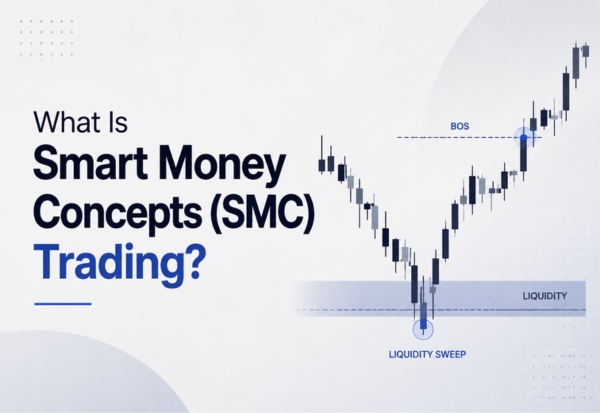
What Is Smart Money Concepts (SMC) Trading?
Have you ever entered a trade right at an obvious support level, only to get stopped out seconds later before the market shoots straight toward your target?
It feels personal. You might even wonder if your broker is watching your screen. The reality is much simpler: retail trading patterns are transparent to big institutions.
The global Forex market is dominated by central banks, hedge funds, and tier-1 financial institutions—collectively known as Smart Money. These players move billions of dollars and cannot simply click “buy” without crashing the order book. They need massive liquidity, and they often engineer it by triggering retail stop-losses.
Smart Money Concepts (SMC) is the framework used to track institutional footprints, decode liquidity traps, and align trades with the true drivers of price action.
Key SMC Terminology at a Glance
|
Concept |
What It Means | How Traders Use It |
|
Market Structure |
The sequence of swing highs and lows (HH/HL or LH/LL). |
Establishes overall higher-timeframe directional bias. |
|
BOS (Break of Structure) |
Price closing beyond a previous swing point in the trend direction. |
Confirms continuation; signals to trade with momentum. |
|
CHoCH (Change of Character) |
Price breaking the opposite swing high/low against the prevailing trend. |
Provides an early signal of structural reversal. |
|
Liquidity Grab / Sweep |
A sharp price spike beyond key levels to trigger stops before reversing. |
Confirms institutional order absorption. |
|
Order Block (OB) |
The last opposing candle before an aggressive, unbalanced impulse. |
Acts as a high-probability entry zone on retracements. |
|
Fair Value Gap (FVG) |
A 3-candle price imbalance showing market inefficiency. |
Marks magnet zones where price returns to rebalance. |
Step 1: Read Market Structure First
Market structure is the foundation of institutional chart analysis. It shows which side of the market is actively distributing or accumulating orders.
- Bullish Structure: Clean patterns of Higher Highs (HH) and Higher Lows (HL) indicate buyers remain in control.
- Bearish Structure: Clear series of Lower Highs (LH) and Lower Lows (LL) shows sellers dominate the order flow.
Trading Rule: Always define your overarching structural bias on the Daily (D1) or 4-Hour (H4) chart before hunting for execution setups on lower timeframes.
Step 2: Spot the Shift — BOS vs. CHoCH :
Price development hinges on two structural pivot events:
- BOS (Break of Structure): When price breaks and closes beyond an existing swing high in an uptrend (or swing low in a downtrend), momentum is intact. Stay aligned with the trend.
- CHoCH (Change of Character): When price takes out a recent swing high within a defined downtrend, sellers have lost control. This marks an early transition point to look for buy setups.
Step 3: Identify Liquidity Pools and Institutional Sweeps:
Retail stop-loss orders naturally gather in predictable zones:
- Equal highs and equal lows (double tops/bottoms)
- Obvious support and resistance line
- Major psychological round numbers
Institutions purposefully push price into these clusters to absorb retail stop orders (creating counter-liquidity for their large positions). When price sweeps past a key level and aggressively snaps back, it signals an institutional liquidity grab rather than a genuine breakout.
Step 4: Locate Order Blocks and Fair Value Gaps (FVG):
Once institutions step in, they leave structural footprints on the chart:
- Order Blocks (OB)
An Order Block is the final opposing candle before a major impulse move.
- Bullish Order Block: The last bearish candle before an aggressive upward rally. It serves as institutional demand when price returns.
- Bearish Order Block: The last bullish candle prior to a steep downward decline. It serves as institutional supply.
- Fair Value Gaps (FVG)
An FVG occurs when extreme market speed creates an imbalance across three consecutive candles. If the wick of Candle 1 and the wick of Candle 3 do not overlap, the empty zone in between represents an unfilled price inefficiency. Institutional algorithms frequently pull price back into this pocket to restore market balance.
The 6-Step SMC Execution Framework
- Determine higher-timeframe structural bias on the daily or 4-hour chart.
- Wait for a Change of Character (CHoCH) on your intermediate execution timeframe (such as 15 minutes or 1 hour).
- Verify that a liquidity sweep has cleared retail stops around key swing levels.
- Mark the unmitigated Order Block or Fair Value Gap left behind by the displacement leg.
- Set limit orders or monitor price action closely as it retests the imbalance zone.
- Place your stop-loss safely beyond the sweep extreme and target opposing liquidity pools for minimum 1:2 or 1:3 risk-to-reward setups.
Frequently Asked Questions
- What does SMC stand for in Forex trading?
SMC stands for Smart Money Concepts—an analytical methodology centred on tracking institutional order flow, bank liquidity accumulation, and structural supply/demand imbalances. - What is the core difference between BOS and CHoCH?
A Break of Structure (BOS) confirms the ongoing trend is healthy and continuing. A Change of Character (CHoCH) signals the first structural failure of a trend, indicating a potential reversal. - Is SMC better than standard retail technical analysis?
SMC provides context on why chart patterns fail. Rather than buying static trend lines or support levels where retail stop-losses accumulate, SMC helps traders enter alongside institutional liquidity runs. - Is Smart Money Concepts suitable for beginners?
Yes, provided foundational chart reading, candlestick mechanics, and risk management are learned first. Layering SMC over strong market basics provides a distinct edge in high-volatility environments. - Master Institutional Forex Trading
Mastering SMC requires moving past retail indicator clutter to understand order flow logic, liquidity mechanics, and structural precision.
The Forex Mastery Course at Focus Trade Academy features comprehensive, practical training on Smart Money Concepts, Key Levels, and live-market execution tailored for aspiring and professional traders across India and the GCC region.
