

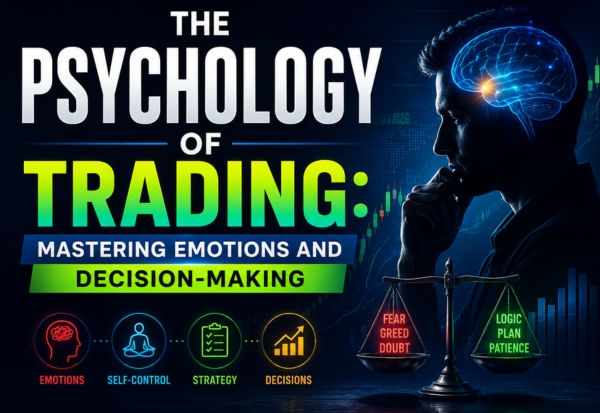
The Psychology of Trading: Mastering Emotions and Decision-Making
Trading psychology is the study of how your state of mind and emotions affect your financial decisions. Most traders are chart, indicator, and market data junkies. But research has shown time and again that emotional discipline, not just technical skill, is what separates the consistently profitable traders from the also-rans. If you are a beginner or have years of experience, learning to understand and manage your psychology is one of the highest return on investment decisions you will make in your trading career.
Why Trading Psychology Matters More Than Strategy
You can have the best trading strategy in the world, but if fear makes you exit a trade too early or greed keeps you in a losing trade too long, that strategy is useless.
The markets are driven by the collective behavior of people. Price changes are the sum of millions of individual, emotional decisions made at the same time. That means that knowing your own emotional triggers not only makes you a better trader but also helps you read the market itself.
The long-term consistently profitable traders are rarely the ones with the most advanced systems. These are the people who have learned to be steady, calm, and rational when the market is really testing their confidence.
The 3 Core Emotions That Drive Trading Decisions
1. Fear — The Invisible Brake
Fear is one of the most common and destructive emotions in trading. It typically shows up in two forms.
Fear of losing money: Traders may hesitate at valid entry points, cut winning trades short, or panic sell on temporary pullbacks for fear of losing money, locking in losses that could have turned into profits if they’d been patient.
Traders are prone to FOMO (fear of missing out), chasing breakouts or entering trades late, buying into momentum that has already topped out. Both are emotional not analytical answers.
The antidote to fear is preparation. A well-defined trading plan removes much of the uncertainty that fear feeds on.
2. Greed — The Dangerous Accelerator
Greed often masquerades as ambition. It causes traders to overtrade, hit stop-losses to avoid small losses, or keep positions way too long after they should have been out trying to get more profit.
Greed is a problem in that it makes you lose perspective of risk. You begin to see potential rewards as greater than they are and potential risks as smaller than they are. The exact opposite of good risk management.
Learning to tell the difference between a rational decision and a need for more is a skill that takes conscious practice to develop.
3. Overconfidence — The Silent Trap
‘Winning streaks build confidence. But overconfidence causes traders to increase positions recklessly, ignore warning signs in the market, and abandon the risk management rules that brought them their wins in the first place.
Real trading confidence is having faith in your process, not your last few results. A good strategy will give losing trades A disciplined trader knows this, and the edge is in hundreds of trades, not days.
The 2 Psychological Traits of Consistently Profitable Traders
Patience — Waiting for the Right Setup
Successful traders know a simple fact. Not every market session is a valid trading opportunity. If you are bored, restless, or trying to make up lost money, then you will make trades that are low-probability setups, and that will eat away at your capital over time.
Patience is sitting on your hands until your specific criteria are met and feeling totally comfortable doing nothing when conditions aren’t favorable. AudioVolumeUpAudioVolumeUpAudioVolumeUpAudioVolumeUp
Discipline — Following Your Plan Under Pressure
Discipline is the line between traders that know what they should do and traders that actually do it when the heat is on. It means putting a stop-loss and not touching it, taking profit at your target and not holding more, and keeping a truthful record of every trade you make, even the ones you’re not proud of.
Discipline is not something that you are born with or without. It is the result of consistent, deliberate practice.
Practical Strategies to Manage Your Trading Emotions
- Develop a written Trading Plan Before you make a single trade, write down your entry criteria, exit rules, position sizing, and max daily loss limit. Writing down a plan gives you an objective reference point to refer to when your emotions try to rewrite the rules in the middle of a trade.
- Set Goals That Are Within Your Control Instead of targeting a specific profit amount each month (which you cannot control), focus on process goals — executing your plan precisely, maintaining your risk rules, and reviewing your trades honestly. An outcome takes care of itself when the process is sound.
- Apply Strict Risk Management on Every Trade Knowing that no single trade can meaningfully damage your account is one of the most powerful emotional stabilizers available. When you risk only a small, defined percentage of your capital per trade, losing trades lose their emotional weight.
- Keep a trading journal record not just your entries and exits but also your emotional state before, during, and after each trade. Over time, patterns emerge — perhaps you overtrade on Mondays, or you tend to revenge trade after a loss before lunch. A journal makes the invisible visible.
- Step Away After Consecutive Losses Most experienced traders have a rule: after two or three consecutive losses, stop trading for the session. This prevents the dangerous mental state known as “tilt”—where frustration clouds every subsequent decision. The market will be there tomorrow. Your capital may not recover so easily.
Frequently Asked Questions About Trading Psychology
What is trading psychology?
The mental and emotional aspects of trading that affect judgment are known as trading psychology. It discusses how trade entries, exits, risk management, and general consistency are impacted by emotions like fear, greed, hope, and frustration.
Why do emotions affect trading performance?
Emotions tend to trigger instinctual responses that are in opposition to logical and rule-based decisions. In fast moving, high pressure environments like the financial markets, careful analysis can be overcome by emotional reactions leading to costly mistakes.
How can I become a more disciplined trader?
Trading is not about willpower, it is about systems and discipline. Have a good trading plan, practice good risk management, keep a trading diary and review your performance regularly. Finally, regular habits leave less room for emotional interference.
Is trading psychology important for beginners?
Yes – and even more so, perhaps, for novices than for experienced traders. It is important to learn mental awareness early to avoid forming bad habits like revenge trading, overtrading and not using stop losses which are harder to break later on.
Final Thoughts
The markets reward those traders who can be rational when everyone else is reacting emotionally. That is a learnable skill—but it takes honest self-awareness, consistent practice, and a willingness to treat your psychology with the same rigor you bring to your strategy.
FocusTrade believes that successful trading over the long term rests on two equal pillars: a sound technical approach and a calm, disciplined mindset. If you enjoyed this post, check out our trading guides and hands-on resources to keep growing both
FOR MORE DETAILS
+919895736500 / +919746195190


1 Comment
James Weighell
A hosted desktop solution allows for the delivery of a consistent and scalable IT experience for all users in an organisation. With this solution, users gain access via a desktop icon or link.